

The Champagne Toast Isn't as Old as You Think
Toasting itself goes back a long way — the custom of raising a glass to wish someone well traces to ancient libation rituals, offerings of wine poured out in honor of the gods or a person's health, long before anyone bottled sparkling wine on purpose. Champagne didn't attach itself to that tradition until much later. It became the wedding-toast default in the late 19th century, once industrial production made it affordable enough for the middle class to buy for a special occasion, not because it has some deeper claim to the moment than any other sparkling wine.
In other words: the toast is the tradition. Champagne is just the brand that got there first during the Gilded Age and never let go of the marketing. Prosecco raising a glass does exactly the same job — it's just not paying two centuries of reputation tax to do it.
The Math Actually Matters
A real bottle of Champagne averages around $50 at US retail, with plenty of well-known labels running $60 to $100-plus once you're buying for a wedding-sized guest list. Quality Prosecco, by contrast, averages just under $18 a bottle nationally, according to industry tracking from the UIV-Vinitaly Observatory. That's roughly a $32 gap per bottle before a single wedding markup gets added on either side.
A standard 750ml bottle pours out to somewhere around 5 to 6 glasses depending on pour size, which means a wedding of 100 guests doing a single toast pour needs roughly 17 to 20 bottles either way. At that $32-per-bottle difference, that's $544 to $640 saved on the toast alone — money that goes a lot further as a late-night snack table or an extra hour of the band than it does as a marginally fancier label on the toast flute.
Americans Are Already Choosing It — the Wedding Industry Just Hasn't Caught Up
This isn't a trend to import from somewhere else. It already happened here. According to the UIV-Vinitaly Observatory, Prosecco overtook Champagne in value in the US sparkling wine market back in 2024 — not a projection, an actual changeover that's already a year old. Distributor data from SipSource confirms it's not a fluke: through the first seven months of 2025, Prosecco held 30% of the US sparkling wine category by both volume and consumer value, ahead of Champagne's 28%.
The gap shows up even more clearly once you look past name recognition. Champagne still wins on raw brand awareness — 52% versus Prosecco's 40% — which makes sense given its head start. But when it comes to what people actually put in their cart, Prosecco converts to a real purchase 31% of the time versus Champagne's 24%. Americans know the name Champagne better, but they're buying Prosecco more. US Prosecco sales hit a record $531 million in 2024 alone, up 178% over the past seven years.
Put plainly: the wedding industry's Champagne-by-default habit is behind where American drinkers already are. Pouring Prosecco at your wedding isn't catching up to a European fad — it's catching up to what your own guests are already choosing at the store.
Lower ABV Means a Better Night, Not Just a Cheaper One
Champagne typically runs about 12% to 12.5% ABV. Prosecco usually comes in lower, around 11%, sometimes closer to 10.5%. That half-to-full point of difference doesn't sound like much on paper, but across an open bar and a long reception, it adds up — a lighter pour means your wedding party and your guests are less likely to be feeling the welcome-drink Prosecco by the time dinner service starts, and more likely to still be upright for the last dance. It's a small, practical reason on top of all the financial ones.
How to Actually Serve It
Prosecco's other advantage over Champagne at a wedding is that it's genuinely more flexible to serve, not just to drink.
As a welcome drink. Prosecco is built for this — pour it the moment guests arrive at cocktail hour, no ceremony required, the way you'd never casually crack a bottle of real Champagne before the toast has even happened.
As the toast itself. This is the obvious swap, and it works exactly the way you'd expect: same glassware, same moment, same "raise your glass," just a different label and a smaller bar tab.
As a self-serve station. Because it's priced to be poured generously, Prosecco works well as an actual DIY mimosa or Aperol-spritz bar for a daytime or brunch reception — something that would feel wasteful to build around Champagne.
With the appetizers, not just the toast. Prosecco's acidity is built to cut through rich, salty cocktail-hour food — cured meats, soft cheeses, fried bites — the same way it does at any other gathering. If you want a starting point, our Easy Italian Appetizers to Pair with Prosecco guide has four recipes built exactly for this window of the night.
Prosecco or Prosecco Rosé: Which One for Which Moment
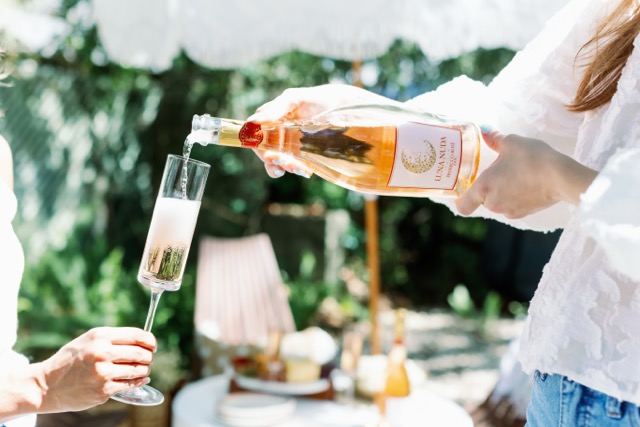
If you're deciding between the two for different parts of the day, here's a simple way to split it. Luna Nuda Prosecco is the classic choice for a welcome drink and the toast itself — crisp, bright, and instantly recognizable in the glass for guests who want the traditional look and feel. Luna Nuda Prosecco Rosé works well for a daytime reception, a bridal shower tie-in, or anywhere you want the drink to double as part of the color palette — its pale pink shows up beautifully in photos without requiring a single extra styling decision.
Either way, both are meant to be opened often and poured generously, which is really the whole point on a day when you're trying to keep several hundred glasses full without a second mortgage on the bar.
What to Look For When Choosing a Wedding Prosecco
Not all Prosecco is built the same, and a little label literacy goes a long way if you want the toast to actually taste good and not just look the part in photos.
DOC vs. DOCG. These are quality designations, not marketing terms. Prosecco DOC is the larger, broader designation covering a wide zone across the Veneto and Friuli regions. Prosecco DOCG is a smaller, stricter designation — hillier terrain, lower yields, generally considered the higher tier. Either can be excellent for a wedding; DOCG just signals a narrower, more controlled production.
Brut, Extra Dry, or Dry. These sweetness labels are famously confusing because "Extra Dry" is actually sweeter than "Brut," not drier — a quirk left over from how the categories were originally named. Brut is the driest and most food-friendly option, the safest all-purpose choice for a toast that also needs to work through the appetizer course. Extra Dry has a touch more residual sugar and reads as slightly softer and fruitier, which some couples prefer for a dessert or cake-cutting pour.
Vintage or non-vintage. Most Prosecco, like most Champagne, is non-vintage — blended across years for a consistent house style. That's normal, not a red flag. A vintage-dated bottle simply means all the grapes came from a single harvest year, which can be a nice touch for a wedding but isn't necessary for the wine to be good.
The short version: for a wedding toast, a Brut DOC or DOCG from a producer you trust covers almost every scenario, and it's the same logic that shaped how Luna Nuda Prosecco itself is made.
Quick Answers
Isn't Prosecco "worse" than Champagne?
No — it's different, not lesser. Champagne is made using a slower, more labor-intensive method that partly explains its higher price; Prosecco is made using a tank method that keeps its fresh, fruit-forward character and keeps costs down. Different production process, different flavor profile, not a quality downgrade. For a full breakdown of how the two actually differ, see our guide: Is Prosecco the Same as Champagne?
Do I still need real Champagne flutes?
Any sparkling-wine glass works fine — flutes, coupes, or modern tulip-shaped glasses all show off the bubbles. Prosecco doesn't require different glassware than Champagne does.
Will guests notice or care that it's not Champagne?
Most won't, and the ones who do are more likely to be pleasantly surprised than disappointed — Prosecco has a strong enough reputation on its own now that it doesn't read as a downgrade unless someone's specifically looking for a reason to be a critic about it.
How much should I budget per guest?
Using the roughly 5-to-6-glasses-per-bottle math above, a single Prosecco toast pour for 100 guests runs somewhere in the neighborhood of $300 to $360 total at typical US retail pricing (around $18/bottle) — versus $850 to $1,000 for the Champagne equivalent at the ~$50/bottle national average — before any wedding-vendor markup, which varies by venue and caterer.
Can I serve Prosecco for the whole reception, not just the toast?
Yes — many couples now build their entire sparkling-wine budget around Prosecco rather than treating it as just a toast-only stand-in, using the savings to serve it more generously throughout the night instead of rationing a single pour.
Does Prosecco need to be served ice-cold like Champagne?
Yes, and if anything it's more forgiving — Prosecco is typically served slightly colder than most white wine, around 40–45°F, which also means it holds up fine sitting in ice buckets around a reception space for a few hours without anyone needing to babysit the temperature.
You Might Also Like
- Is Prosecco the Same as Champagne? Here's the Real Difference
- Easy Italian Appetizers to Pair with Prosecco
- How Long Does Wine Last Once It's Opened?
- The Luna Nuda Guide to Pairing Italian Wine With Food
Responsible drinking note: enjoy Luna Nuda wines responsibly and in moderation.