


The Short Version
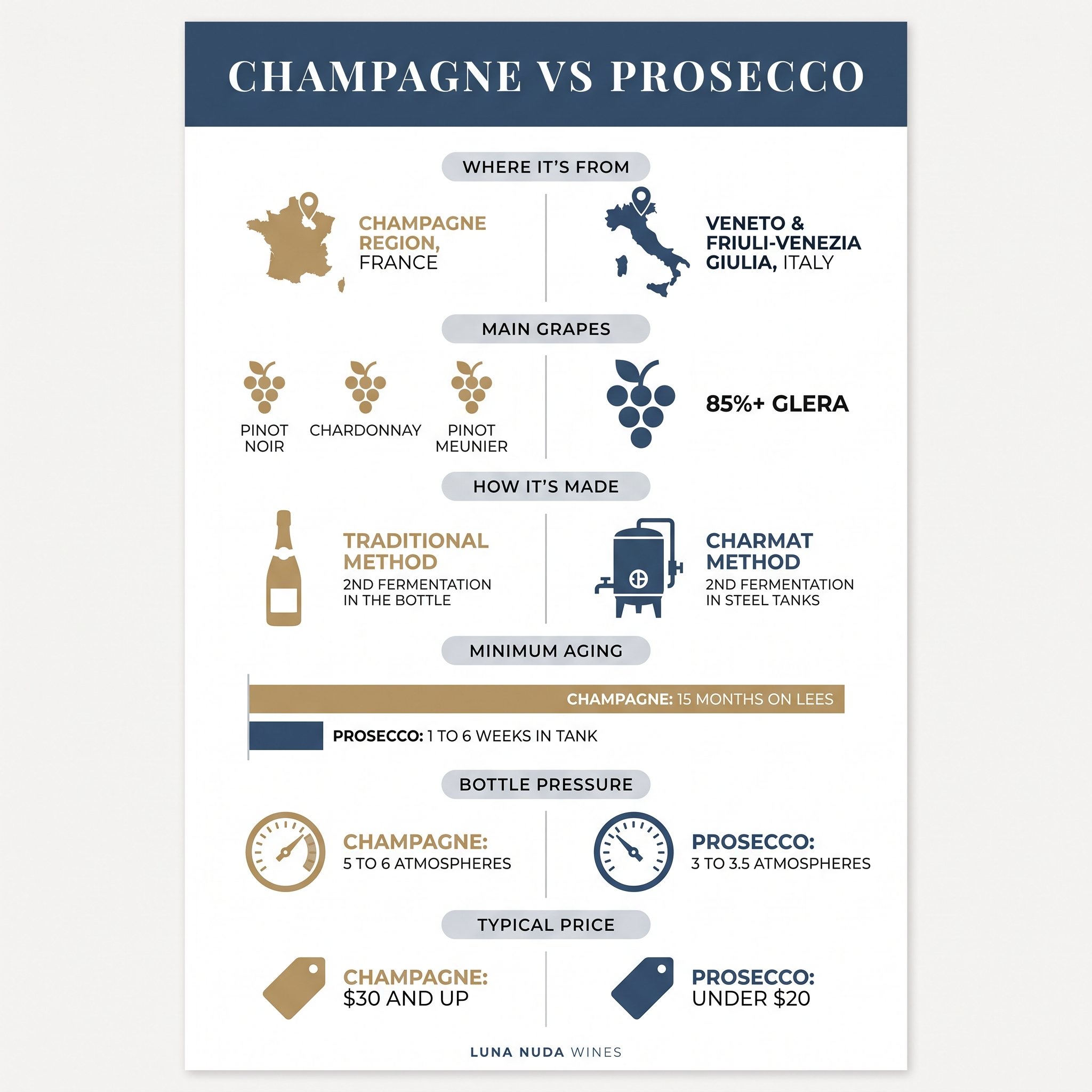
Champagne only comes from the Champagne region of France, made mostly from Chardonnay, Pinot Noir, and Pinot Meunier, and fermented a second time right in the bottle over a minimum of 15 months. Prosecco comes from Veneto and Friuli-Venezia Giulia in Italy, made almost entirely from Glera, and fermented a second time in large pressurized tanks over a matter of weeks. Different place, different grape, different method, different price point — the same basic idea of "wine with bubbles in it," carried out two very different ways.
Where They're From
Champagne only comes from Champagne — the actual region of northeastern France, not just a style. The name is legally protected there, which is why sparkling wine made anywhere else in the world technically can't call itself Champagne, no matter how it's made. The region covers roughly 34,000 hectares spread across five main districts: Montagne de Reims, Vallée de la Marne, Côte des Blancs, Côte des Bar, and Côte de Sézanne.
Prosecco's protection works the same way, just across more ground. The Prosecco DOC zone spans nine provinces across the Veneto and Friuli-Venezia Giulia regions in northeastern Italy. Within that larger zone sits a smaller, hillier area — Conegliano Valdobbiadene, along with neighboring Asolo — that earns the higher DOCG designation, Italy's top quality tier for wine. Luna Nuda Prosecco comes from Treviso, produced by Cantina Montelliana, right in that broader Prosecco heartland. (More on where Luna Nuda's wines actually come from, if you want the full picture.)
Inside the Conegliano Valdobbiadene DOCG is an even smaller pocket called Cartizze — just over 100 hectares, sometimes nicknamed the "grand cru" of Prosecco. If you ever see Cartizze on a label, that's a signal the grapes came from a very specific, very small hillside, not the broader production zone.
How They're Made
This is the biggest technical difference, and the one that explains almost everything else about how the two wines taste and cost.
Champagne uses the traditional method — méthode champenoise, though outside the region it legally has to be called méthode traditionnelle. After the base wine is made, it goes through a second fermentation inside the very bottle you'll eventually open, triggered by adding a small amount of sugar and yeast. That second fermentation is what creates the bubbles, and the wine then rests on its spent yeast cells — the lees — for a minimum of 15 months by French law for non-vintage Champagne, and 36 months for vintage. In practice, most houses go well past the legal minimum: two to three years for non-vintage, four to ten years or more for vintage. That extended lees contact is what gives Champagne its toasty, bready character — brioche, biscuit, sometimes a faint nuttiness.
Prosecco uses the Charmat method, sometimes called the Martinotti method after the Italian scientist who patented an early version of it. The second fermentation happens in large, sealed, pressurized steel tanks instead of individual bottles — typically taking anywhere from one to six weeks, not months or years. The wine is bottled already carbonated, rather than developing its bubbles bottle by bottle over an extended rest. It's a faster, less labor-intensive process, and it's exactly why Prosecco tastes the way it does: brighter, fruitier, and more floral, without the yeasty depth that comes from months of lees contact. Luna Nuda Prosecco and Prosecco Rosé are both made this way, at Cantina Montelliana in Treviso.
What Grape Goes Into Each
Champagne is built primarily on three grapes: Pinot Noir (the most widely planted, at roughly 38% of the region's vineyards), Pinot Meunier (about 31%), and Chardonnay (about 31%). Four additional varieties are legally permitted but barely used — Pinot Blanc, Pinot Gris, Arbane, and Petit Meslier together make up less than half a percent of all Champagne vines, kept alive mostly by a handful of growers preserving older traditions.
Prosecco is built almost entirely on one grape: Glera, which has to make up at least 85% of the blend, with the remaining 15% allowed to come from a short list of local and international varieties. (Glera used to be called "Prosecco" itself — Italy renamed the grape in 2009 specifically so "Prosecco" could become a protected place name instead of just a grape name, the same logic that protects "Champagne.") Luna Nuda Prosecco is 90% Glera and 10% Chardonnay.
Different starting materials make for a different finished wine. Champagne's grape blend leans toward structure and acidity that can hold up to years of aging, while Glera is prized for its natural aromatics — the floral, orchard-fruit character Prosecco is known for straight out of the tank.
Bubbles and Pressure
Pour both side by side and the bubble difference is obvious before you even taste anything. Champagne is bottled under roughly 5 to 6 atmospheres of pressure — about 90 psi, close to three times the pressure inside a car tire — which produces very fine, persistent bubbles that can keep streaming for hours in the glass. Prosecco typically sits at 3 to 3.5 atmospheres, noticeably softer and gentler, with slightly larger bubbles that fade a little faster.
Neither is "better" — it's a direct result of how each is made. Champagne's months-long bottle fermentation and extended lees aging naturally build more pressure over time. Prosecco's shorter tank fermentation is calibrated to produce that lighter, more approachable fizz on purpose.
Sweetness Levels, Decoded
Both wines get labeled with sweetness terms that sound similar but don't line up the way you'd expect — and this is where a lot of the real confusion happens, more than the country-of-origin question.
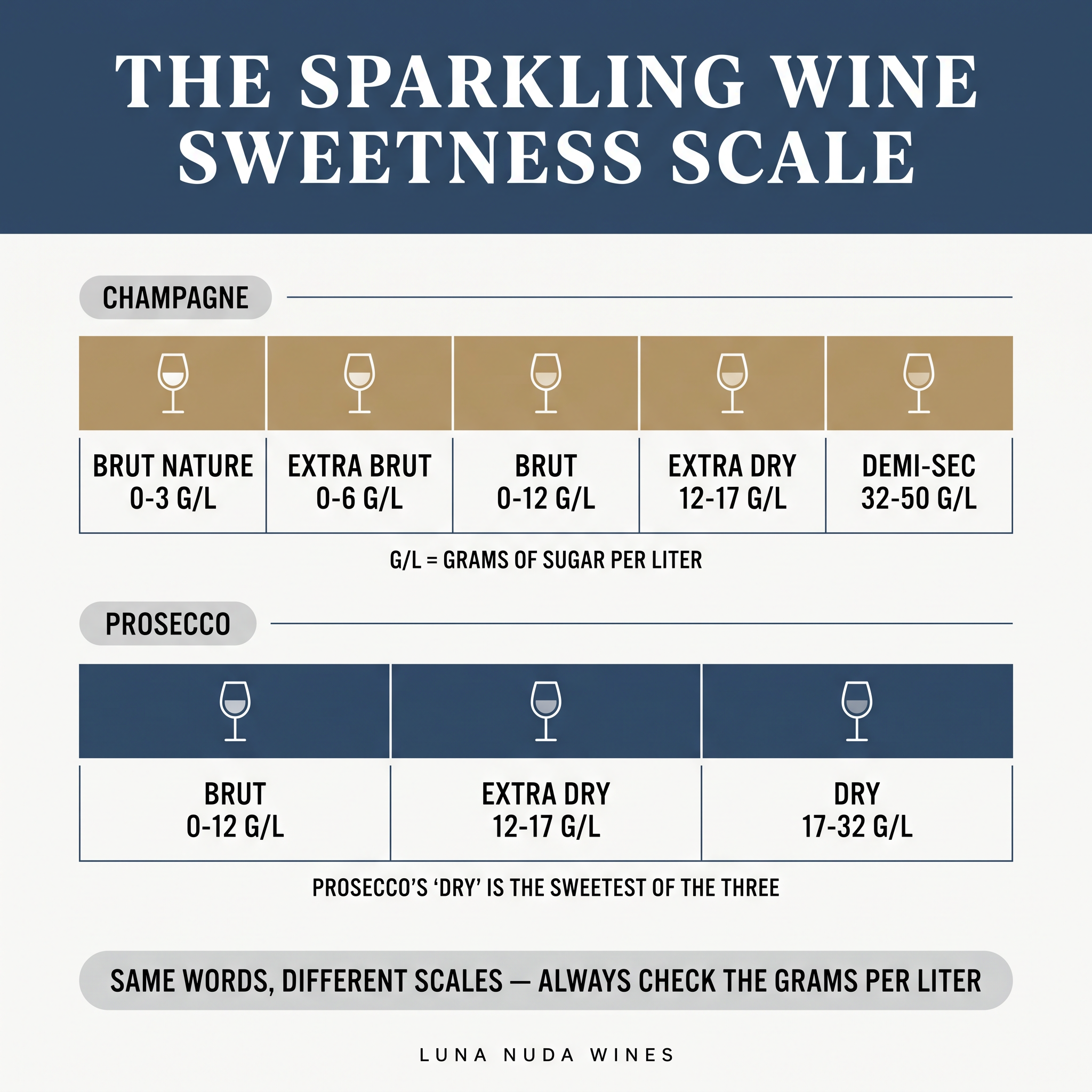
Champagne's sweetness scale runs, from driest to sweetest: Brut Nature (0 to 3 grams of residual sugar per liter), Extra Brut (0 to 6 g/L), Brut (0 to 12 g/L — the style you'll see most often), Extra Dry or Extra Sec (12 to 17 g/L), Sec or Dry (17 to 32 g/L), Demi-Sec (32 to 50 g/L), and Doux (50+ g/L, rare today).
Prosecco uses some of the same words but a shorter scale — and here's the part that trips people up: Prosecco's "Dry" is actually sweeter than its "Extra Dry," which reads backwards if you're used to still-wine labeling. Prosecco Brut runs 0 to 12 g/L, Extra Dry runs 12 to 17 g/L, and Dry runs 17 to 32 g/L, making it the sweetest of the three common styles despite the name. Most Prosecco poured in the U.S. is labeled Brut or Extra Dry.
What They Taste Like
Champagne tends to lean toastier and yeastier, with aromas like brioche, baked apple, and sometimes a faint nuttiness — a direct result of that long bottle-aging process. It's more structured, often more acidic and mineral-driven, built to be sipped slowly and to age well if you let it.
Prosecco is brighter and more immediately fruity: think golden apple, white peach, pear, and honeysuckle, with a softer texture and gentler acidity. It's built to be enjoyed young — most Prosecco is meant to be drunk within a year or two of release, not cellared. Neither style is "better." Champagne rewards patience and a slower sip; Prosecco rewards a Tuesday that didn't need an excuse.
Quality Tiers Within Each Category
Not all Champagne is the same tier, and not all Prosecco is either — which matters if you're comparing a $20 bottle of one to a $60 bottle of the other and wondering why the gap is so wide.
Champagne comes in a few recognizable tiers. Non-vintage (NV) blends multiple years together for consistency, and it's what most people actually drink day to day. Vintage Champagne comes from a single exceptional year and ages longer before release. Grower Champagne comes from small, independent growers who make their own wine instead of selling grapes to the big houses, often at a lower price for genuinely high quality. And prestige cuvées — the Dom Pérignons and Cristals of the world — sit at the very top, often $150 and up.
Prosecco has its own hierarchy, mostly based on where the grapes are grown. Straight "Prosecco DOC" covers the broad nine-province zone and is the most widely available style. "Prosecco Superiore DOCG" comes only from the smaller, hillier Conegliano Valdobbiadene zone and generally shows more depth and complexity. Cartizze, from that tiny hillside pocket within the DOCG, is Prosecco's top tier — harder to find and priced accordingly, though still nowhere near prestige Champagne prices.
What They Cost
Champagne's labor-intensive process and legally protected status generally keep prices higher — a decent non-vintage bottle usually starts around $30 to $50 and climbs quickly from there, with vintage and prestige cuvées running well past $100. Prosecco's faster production method keeps prices down across the board, with most bottles landing under $20, and Superiore DOCG bottles occasionally reaching into the high $20s or $30s.
That price gap isn't a quality signal so much as a production-cost signal. You're not paying less for Prosecco because it's a lesser wine — you're paying less because tank fermentation is faster and less labor-intensive than fermenting each bottle individually and aging it for years. It's a big part of why Prosecco has become the everyday-celebration wine of choice, and why Luna Nuda Prosecco can taste like a much pricier bottle without actually costing like one.
Other Sparkling Wines Worth Knowing
Champagne and Prosecco get most of the attention, but they're not the only two sparkling styles worth knowing, especially if you're building out a wine vocabulary.
Cava is Spain's answer to Champagne — made using the same traditional bottle-fermentation method, just outside the protected Champagne region, mostly from the Macabeo, Xarel-lo, and Parellada grapes. It typically costs closer to Prosecco than Champagne, which makes it a solid option if you want that traditional-method character without the traditional-method price tag.
Crémant is a catch-all term for traditional-method sparkling wine made in French regions outside Champagne — Crémant de Bourgogne, Crémant d'Alsace, and others. Same bottle-fermentation process, different and usually more affordable region.
Franciacorta is Italy's answer to Champagne rather than to Prosecco — made in Lombardy using the traditional bottle-fermentation method, not the Charmat tank method. It's less internationally famous, but respected among wine people for applying Champagne's slower, more expensive process to Italian grapes.
None of these are what's in a bottle of Luna Nuda Prosecco, but they're useful context: Prosecco is the fast, approachable, Charmat-method option, while Champagne, Cava, Crémant, and Franciacorta all share that slower, bottle-fermented tradition.
Serving It Right
Temperature matters more than people think for both. Champagne is best served well-chilled, around 45 to 48°F — cold enough to keep the bubbles tight without numbing the flavor entirely. Prosecco can go slightly colder, around 40 to 45°F, since its brighter fruit character holds up well to a colder pour.
Glassware is a smaller deal than wine culture makes it out to be, but a tall, narrow flute helps either wine hold its bubbles longer than a wide coupe glass will — worth knowing if you want your pour to still be fizzy by the second half of the glass.
Which One Should You Pour?
Reach for Champagne when you want the ceremony of a genuinely special occasion and the price tag doesn't change your mind — an anniversary, a milestone, a moment you want to remember pouring.
Reach for Prosecco when you want that same lift — the toast, the bubbles, the occasion — without needing an occasion to justify it. That's really the whole appeal: a glass of Luna Nuda Prosecco doesn't ask you to wait for something worth celebrating. It just asks for a Tuesday.
Quick Answers
Is Prosecco cheaper than Champagne because it's lower quality?
No. It's cheaper because the Charmat method is faster and less labor-intensive than fermenting in the bottle for months or years — not because the wine itself is inferior. Price reflects production method and legal protections, not a quality ranking.
What's the difference between Prosecco and Cava?
Cava is Spain's version of the same idea, but it's made using the traditional bottle-fermentation method, like Champagne, just outside the protected Champagne region. Prosecco uses the Charmat tank method, which is what gives it its lighter, fruitier character.
Can I use Prosecco instead of Champagne for a toast or mimosas?
Absolutely. Prosecco's bright, fruity profile actually works better in a mimosa than Champagne does — its flavor holds up next to orange juice instead of getting lost in it.
Is Prosecco always sweeter than Champagne?
Not necessarily — it depends on the specific style. A Brut Prosecco (0 to 12 g/L) can be just as dry as a Brut Champagne. What's true is that Prosecco's most common U.S. style, Extra Dry, reads slightly sweeter than a typical Brut Champagne — and confusingly, Prosecco's "Dry" label is actually the sweetest of its three main styles.
Does Champagne actually taste better than Prosecco?
That's a matter of what you're looking for, not an objective ranking. Champagne offers more complexity and aging potential; Prosecco offers brighter, more immediate fruit at a fraction of the price and effort. Quality varies more within each category than it does between them — a well-made Prosecco can easily outshine a mediocre Champagne.
Can Prosecco be aged like Champagne?
Not really, and it's not meant to be. Prosecco is a Charmat-method wine built for immediate, fruity drinking — most is best enjoyed within a year or two of release. Champagne's bottle fermentation and extended lees aging are specifically what give it the structure to improve with age. Holding onto Prosecco doesn't get you a better wine, just a tired one.
Pour What Pairs
Whichever one you reach for, Luna Nuda Prosecco and Prosecco Rosé are built to prove that Charmat-method sparkling wine doesn't have to be an afterthought — Treviso-grown, made the traditional Charmat way, and priced for a Tuesday that decided to be a little more than a Tuesday.
Responsible drinking note: enjoy Luna Nuda wines responsibly and in moderation.